STRING PHYSICS |
|
What many players do not realise, yet something that every professional acknowledges, is that the strings you use account for 70% of your racquet's playability! Professionals have their racquets freshly strung prior to each match due to this fact. Racquet manufacturers do not advertise this truth, as their business is to sell you the most expensive racquet possible, and have you believe that it is only the frame that is important. Choose to play with a high quality string, and you will notice a complete improvement in your racquet. POLYFIBRE strings have been developed in the U.S over the last 12 years to enable us to provide you with this high level of quality. |
Why strings provide 70% of a racquets playability |
|
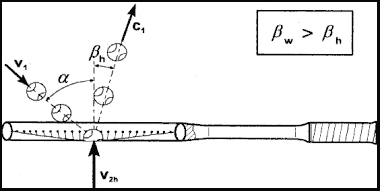
The tension of the string in a tennis racquet is what keeps the balance between providing power and precise control of a tennis ball. The tighter the tension the greater the control, the lower tension the greater the power. So why does a tightly strung racquet result in a slower ball speed? Official regulations state that when a tennis ball is dropped from a height it is not allowed to bounce back to more than 55% of the height from which it was dropped. This means that all balls lose nearly half their energy, or ball speed, on impact. On the other hand, when you hit a ball with a racquet, the stretch or 'give' of a quality tennis string only reduces the ball speed by 6%! High quality tennis string can therefore be described as an almost perfect spring. These factors combine to result in the relationship we can see between ball and racquet. A tighter string tension leads to a lesser deformation of the string, and a greater deformation of the ball. Since the deformation of the ball is what causes it to lose most of its energy, a higher tension results in a slower ball speed. Conversely, a lower tension will allow the string to deform the most, and the ball to deform the least. This allows the ball to retain most of its energy and proves that a lower tension allows us to hit the ball faster. So why does a tightly strung racquet give more consistent and predictable control of the ball? If the string is strung too loosely it can lead to an uncontrollable bounce known as the 'trampoline effect', illustrating that a lower tension string gives you less control of the ball. This effect however, only occurs when the string tension is extremely low. After all, no one is able to play tennis with a "butterfly catcher"! The relationship between string tension and ball control can also be explained in another way: a loose restring arches greatly when the ball dips onto the racquet head and results in the ball bouncing back from the racquet with a bigger angle of inclination. Sounds complicated? To help show you how this works please see the diagram below:
Because of the high energy loss associated with a large deformation of the tennis ball, a tightly strung racquet must be swung at higher speed (V2) then a loosely strung racquet to produce the same ball speed. However, the faster the racquet is swung, the smaller the angle with which the ball rebounds, and the more the ball is forced to follow the direction of the racquet. The more the ball now follows the direction the racquet intended, the more 'control' you have! An example from a real tennis match should make this theory clear: If the oncoming ball has much spin, and you return it with a tightly strung racquet, the ball will flatten out and the spin will become ineffective, making it easier to control. Conversely, if the player hits a soft stroke such as a drop shot, which doesn't result in the ball flattening against the racquet head, then the spin of the ball remains and decreases the control of your shot. This may explain why even professionals often find drop shots hard to control! |
What does this mean for you? |
|
When choosing a string tension you have to consider this conflict between power and control. You can either choose a low racquet tension, which results in fast but uncontrollable ball, or a higher tension, which allows for a slower ball but better ball control. Most racquets have their recommended tensions stated on the frame. Based on your needs for power and control, you should string your racquet within this range of suggested tensions. |
 |
 |
 |
 |  |
|  |
| Please wait while the contents load |
 |
 |
 |
 |